
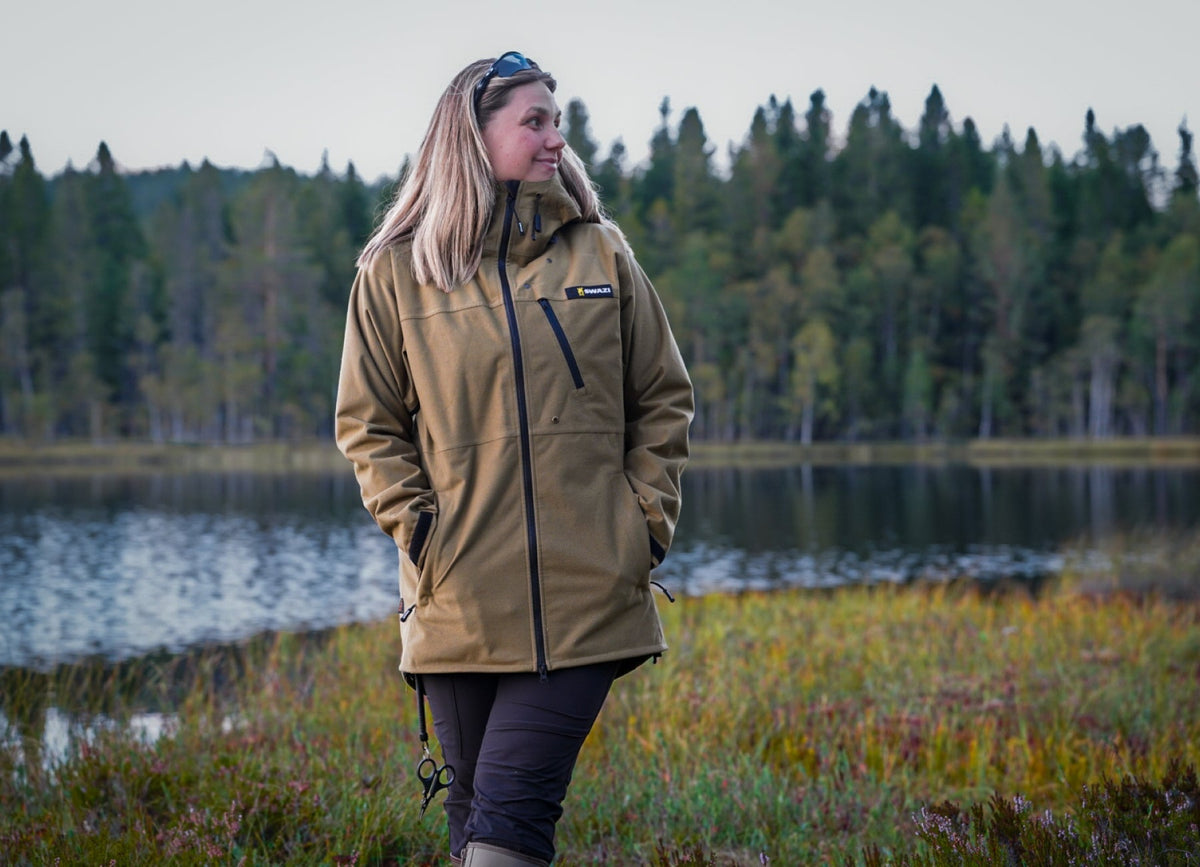
Norway's outdoor culture runs deep, and we don't say that lightly. Friluftsliv isn't a trend there, it's generations deep, built into everyday life through the right to roam and a genuine respect for the land. Some of Swazi's staunchest supporters live there, hunt there and fish there, and Maria and Stephan are two of them, chasing spring trout, training for hunting season, or just packing the car and seeing where a Norwegian back road takes them.
We asked them what got them into the outdoors, what a good day out actually looks like, and what people outside Norway usually get wrong. Over to Maria and Stephan.
Tell us a bit about yourselves: how you met, and how Ipa became part of the adventures.
We actually met on a night out at a bar, which is quite funny considering that's probably the complete opposite of where we feel most at home today.
Ipa has been a natural part of our outdoor life since the day we got her. We chose a Working Cocker Spaniel because we wanted an active dog that could join us outdoors and eventually become a hunting and working dog. She's been part of pretty much every adventure since she was a tiny puppy, whether we're fishing, camping, hiking, travelling or training for hunting.
Today, the three of us are very much a package deal.
What first got you into the outdoors?
For me, it definitely started with my family. My grandfather and my parents were all into hunting, fishing and outdoor life, and some of my best childhood memories are from summers and winters at our family cabin.
There was always fishing, being outside, road trips, camping and just spending a lot of time in nature. I think that's where it became such a natural part of life for me.
Stephan was introduced to a lot of it through me as an adult. Luckily for him, he ended up loving it just as much as I do.
What does Stephan bring to the adventures, hunting, fishing, or something else?
If you ask what Stephan brings, the answer is usually a Swazi cap, fishing gear, a power bank, a good flashlight and Norwegian lefser with cinnamon and sugar. So basically all the essentials.
What outdoor tradition did you grow up with that still shapes how you get outside today?
Definitely fishing and the simple way of being outdoors. I grew up with lots of time at the cabin, fishing trips, road trips and camping with my parents and grandparents.
We do a lot of the same things today. Pack the car, bring the fishing gear and camping equipment, find somewhere beautiful and see where the trip takes us. It doesn't always need to be a big expedition to be a good adventure.
Which season do you look forward to most, and what does it mean for what you're out doing?
Spring is probably number one because of the spring fishing. When the trout become really active again after winter, it feels like the proper start of a new outdoor season. Autumn is a very close second. It can be amazing for fishing, especially at night, and then of course there's hunting season as well. There's just something special about being in the mountains and forests at that time of year.
Is there a bit of friluftsliv wisdom, a rule of thumb, or something you were taught, that you still live by?
Probably not to make outdoor life more complicated than it needs to be.
You don't always need the longest hike, the biggest mountain or perfect weather for it to be a good trip. Some of our best memories have come from simply packing the car, finding a lake, putting the packrafts on the water and seeing what happens.
"There's no point waiting for perfect weather, because you might be waiting for a very long time."
What does a good day out actually look like for you, start to finish?
Coffee first. Always.
Then we'll usually pack far too much fishing gear, food, Ipa's equipment and whatever else we think we might need. A perfect day would involve finding a quiet lake somewhere in the mountains, getting the packrafts on the water and spending most of the day fishing.
There's no real rush. We'll stop for food, make coffee, let Ipa explore and hopefully catch a few trout along the way. Ending the day by the water with tired legs, a tired dog and something good to eat is pretty hard to beat.
Is there something outdoors you haven't tried yet but still want to get into?
One thing we really dream about is doing a longer journey across the Norwegian high mountains, preferably spending most of the trip above 1,000 metres. We'd love to pack everything we need, hike for several days or longer, and live out of our tents along the way. That's definitely high on the list.
Favourite spot to switch off, and one thing you never head out without.
Put us in a packraft on a quiet mountain lake surrounded by Norwegian nature and we switch off pretty quickly. As for the one thing we never leave without, probably fishing gear. Even when we tell ourselves we're not going fishing, somehow a rod usually ends up coming with us anyway.
What first brought Swazi into your kit, and how has it performed through a season out?
We wanted outdoor clothing that could actually handle the way we use it. We're outside a lot, Norwegian weather isn't exactly gentle on your gear, and it's barely left a mark on any of it.
Which pieces have earned a permanent place in your pack, and why?
Stephan would choose his Sentinel Jacket and Ipotane Pants without a second thought. The quality is fantastic; they can take a lot of use, and the Sentinel especially has been brilliant in heavy rain. They're the kind of pieces he automatically grabs when we're heading out because he knows they'll handle whatever the weather does.
For me, it's the Artemis Jacket. It's warm, tough, and rain just seems to roll straight off it. I love that I don't have to be careful with it; it's comfortable and genuinely made to be used.
Why do you think Swazi appeals to Norwegian hunters and outdoors people?
It makes a lot of sense for Norway. Our weather can change ridiculously fast, and when it gets rough, it gets really rough. We also spend a lot of time moving through mountains, forests and wet terrain, so clothing needs to handle wind, rain and plenty of wear.
Norwegians are also very connected to hunting, fishing and friluftsliv, so people appreciate gear that's genuinely made to be used outdoors rather than just looking outdoorsy.
"They're not clothes we feel like we need to protect. We can just wear them and get on with the adventure."
What's the story behind @adventuresofipa_? What made you start sharing your adventures online?
It actually started because I wanted Ipa to have her own Instagram account so I didn't have to spam everyone on my private account with dog pictures.
Then our outdoor life became a bigger part of it, and I got more interested in photography and creating content, so it developed quite naturally. There was never really a big plan behind it, which I think is part of why it still feels like us.
Anything you'd love to see more of from Swazi: product, colours, or content?
More women's products, definitely, and especially more trousers. We actually really like the colours Swazi already has, so we wouldn't want that to change too much.
Content-wise, we'd love to see even more real-life situations. Hunting, fishing, bad weather, long days outside, the kind of situations where you really get to see what the clothing can handle. That's the content we personally relate to the most.
What do you think is special about the Norwegian outdoors that people outside Norway might not realise?
One of the most special things is how accessible nature is here. You don't have to travel very far before you can find mountains, forests, rivers or a lake where you can feel completely alone.
And thanks to our right to roam, being outdoors is deeply rooted in the way we live. You can hike, camp and explore huge areas of nature quite freely, as long as you treat the land and people around you with respect.
But people sometimes underestimate how wild Norway can feel. The weather can change in minutes, summer nights barely get dark in the north, and for us, that freedom is probably the best part of Norwegian friluftsliv.
"You can be sitting completely alone on a mountain lake catching trout with nothing but mountains around you."
That's the thing about Maria and Stephan, nothing about the way they get outside is complicated. Pack the car, respect the land, and let the weather do what it wants. It's the same freedom that's shaped Norwegian friluftsliv for generations, and we're proud Swazi's earned a small place in it. Give them a follow to keep up with their adventures.
Follow Maria, Stephan & Ipa: @adventuresofipa_


Share:
Ambassador Profile: Jared Matthews